A History of LGBTQ Representation in Video Games
- sheacooke
- Jan 13, 2021
- 13 min read

“Pixel Pride Hearts” by author
Video games as a form of media are comparatively young having only existed for around 70 years. Gaming has since grown into a multi-billion-dollar phenomenon with 2020 expected to bring in $159.3 billion for the games industry worldwide.[1] Given the amount of money involved at the highest level companies are not likely to take the risk of angering their perceived primary audience – heterosexual white men. Thus LGBTQ+ representation has been rare in the medium and the representation that we do see is “safe and gentle” [2] at best or problematic and violent at worst. However, through the decades we see LGBTQ+ representation becoming more common with each passing year as companies start to broaden their audience and take risks. The video game industry has grown in multiple ways over the past 70 years with all aspects of that growth, good and bad, helping shape the representation landscape for all gamers, even those outside the primary cis-heterosexual audience.
1970s – The Popularization of Video Games
In 1972 the game Pong was released into the world. While it is commonly cited erroneously as the first video game created, the formative effects of Pong on the gaming industry are indisputable. Originally released as an arcade game Pong found its home in video arcades but it was not long until it found its way into homes. Trying to capitalize on the unprecedented success of the game “Atari released Home Pong, an all-in-one console, controller, and game that allowed players to play Pong at home on their television sets.” [3] This step of games into homes led to the formation of gaming consoles as a market as well as the idea of video games as a home entertainment system.
The gameplay of Pong is relatively simple, and its graphics reflected the sophistication of technology at the time.
…inspired by the sport of ping-pong. The original Pong is a rudimentary game; only the paddles, the ball, the net, and the score appear on-screen. It has no narrative [and] no characters… [4]

An image of Pong. From The Guardian
https://www.theguardian.com/technology/2008/apr/17/games.atari
While the game has no explicit LGBTQ+ representation it is not unfounded to say that without Pong video games as we know them today would not exist and thus there would be no representation to study.
1980s – Beyond Pong
Representation in the 1980s comes mostly from games created in Japan which were localized for an American audience. Due to strict regulations by publishing companies and perceived values of the United States population the content in early games were adjusted from their original rendition to create some of the first transgender characters in the medium.
Appearing as a pink dragon-like character with a bow on her head Birdo from 1986’s Super Mario Bros. 2 is described as thinking “he is a girl” and would “rather be called ‘birdetta.’”[5] Within the game Birdo is considered an enemy that the protagonist, Mario, must defeat to move forward. The idea of LGBTQ+ characters being enemies for the protagonist to fight is an early trend in video games, one that is perpetuated for years. It is unclear if Birdo’s gender identity is a result of censorship regarding violence against female characters or if she was intended to be transgender from the start.

Super Mario Bros. 2 Manual. From Nintendo Japan. https://www.nintendo.co.jp/clv/manuals/en/pdf/CLV-P-NAADE.pdf
Despite Birdo being accepted today as a character from the Mario universe originally Birdo appeared in the Japanese game Doki Doki Panic. This game was created by the same team that was responsible for the original Super Mario Bros. and was released exclusively in Japan. However, when Doki Doki Panic was brought over to western audiences the team “swapped the game’s [original] characters out for the Mario cast”[6] and renamed the game to Super Mario Bros. 2. Birdo survived this transition and thus was officially considered a Mario character. Birdo’s infamy lives on in the numerous Mario sequels where Birdo’s gender has evolved from “becoming a [transwoman], [to becoming] a [cis-woman,] and then returning back to [her] origins.”[7] Even today each game where Birdo makes an appearance seems to change her sex with some still holding onto the history of Birdo’s transness while others erase it.
Among other early transgender enemies in video games is Poison from a 1989’s Final Fight. Like Pong, Final Fight was originally an arcade game that later was brought to home consoles such as the Super NES.[8] Poison’s origins as a transgender character are disputed, however, as some claim she was only made to be transgender when the game was ported to the Super NES “because of Nintendo censorship that forbade representations of violence against [women…]” [9] The solution to get around these problems without rewriting code or remaking game assets was to make Poison transgender as then she was not considered a real woman. However, early concept art of Poison described Poison as “newhalf” which is the “Japanese word for transsexual.”[10] This concept art brings up an interesting counter point to the narrative that Poison was only made to be transgender because of porting concerns.

Poison Concept Art. From “Ontology of Gender in Computer Games” https://journals.openedition.org/map/1631
1990s – The Introduction of ‘Self Insert’ Games
The trend of queer characters as deviant enemies continued into the 1990s with notable examples from the side scrolling fighting games Vendetta (1991) and Streets of Rage 3 (1994). In Vendetta “players faced queer-coded enemies in leather with exaggeratedly effeminate walking animations who… dry-hump the player as an attack…” whereas in Streets of Rage 3 players faced “…the midboss Ash… an effeminate leather daddy wearing a Venus symbol around his neck whose running animations play off of the stereotype of the male sissy.” [11] When both these games were localized to the United States, however, the enemies were removed from gameplay but remained in the game’s code.

Queer-Coded enemies in Vendetta. Screenshot taken by author from “Is Ghirahim Gay or Just Coded That Way? | Queer Tropes in Video Games”
https://www.youtube.com/watch?v=w-5jnTv-OMg&ab_channel=FeministFrequency
Thankfully later in the 1990s we see a new genre of game become popularized. 1997’s Fallout you play as “The Vault Dweller” in a post-nuclear holocaust United States. In Fallout players get to choose their name, age, and gender allowing players to “self-insert” themselves into the game. During gameplay gender rarely plays a role except during sex. In Fallout there is an option as a female player character (PC) to have sex with another female, though the requirements the player must meet to do so means that many players are not able to engage in this content. Fallout 2 sees these requirements loosened however the options for queer content are still sparse.
Generally speaking, the presence of queer in video games is subtle and takes the form of the ability to make ‘queer’ choices and the player is not pushed or forced in that direction… Fallout’s bestowment of the power of choice means that the player is given control over demographic representation, at least in regard to the PC. [12] While far from the first computer role playing game (CRPG) Fallout helped set a standard for modern RPGs to follow which included an emphasis on player choice. This player choice is integral to the development of queer representation in video games however it is not without its problems. As mentioned previously the action of engaging in queer choices is optional which brings up a debate of the validity of the representation. Regardless of the efficacy of the LGBTQ+ representation in these early RPGs they set the stage for queer representation to be expanded on in modern, successful RPGs.

Screenshot of Fallout (1997). Taken by author.
2000s – Queer Characters as Player Characters and Friendly NPCs
In the early 2000s we see the continuation of Fallout’s impact on the video game industry with titles such as Fable (2001) which shares the same emphasis on player choice. In Fable players can marry any non-player character (NPC) regardless of gender and even be married to multiple NPCs at once though the latter has been attributed to a “coding error.” [13] However, in the sequel Fable II (2008) more game mechanics were added to make a more “realistic” experience which included a “cross-dressing stat” and specified sexual orientations for all NPCs. The result was a more heteronormative experience as it included clearly gendered clothing and punished players for dressing against their chosen gender.
Further expanding on the formula of RPGs was 2007’s Mass Effect. Bioware mixed the player choice of Fallout and Fable with a more narrative driven experience, focusing more on creating characters and story than creating a sandbox for the player. Mass Effect’s story centers around the human player character Commander Shepard in their attempt to save the galaxy from an ancient alien threat. Along the way Shepard accrues a variety of alien and human crewmates who the player can romance should they desire. Regardless of if the player chooses a male or female PC one of the romance options is an Asari alien, Liara T’Soni. “While [Asari] do not find gender to be a useful means of delineation among themselves, Asari are traditionally feminine in appearance [and] utilize female pronouns.” Given that “Asari can romantically meld and reproduce with any gender or species”[14] as a species they tend to fall under the label of bisexual as is the case with Liara.
When asked about their LGBTQ representation Bioware “developers originally ‘assumed that the player base would never accept [it.]’ Later, they realized that by writing about romance and sex, they were inevitably saying something ‘about what was acceptable and what was normal, and who we thought our audience was…’” [15]
The 2000s also saw LGBTQ+ characters being represented beyond relationships with PCs or as violent props for the player. In 2002 we see the introduction of a gender non-conforming character, Bridget from Guilty Gear XX.
The plot of Guilty Gear XX is interesting: Bridget has born male in a little town where the birth of twins of the same sex is considered bad luck. His family named and raised him [as a girl.] Becoming [an] adult, Bridget decides to explore his gender. During the course of the plot, he is deceived by his friends and many men do not understand that he is male: Bridget refuses their attentions and is attracted [to women.] [16]

Character Art of Bridget. From Wikipedia.
Though Bridget identifies as a male he dresses in commonly feminine clothing and has long blonde hair. At first glance people often mistake him for a woman and without context of his story it is easy to make that mistake.
We also see numerous other friendly NPCs with specified orientations such as Pierre and Gerard in Shadow Hearts: Covenant (2004)[17] and Tommy in Indigo Prophecy (Fahrenheit) (2005).[18] Though the former is played off as comedy and the latter is stated in a possible to miss dialogue it is still important that queer characters are being represented passively.
2010s – The Rise of Indie Development
In 2013 The Last Of Us was released on the Playstation 3 as a post-apocalyptic narrative driven game with queer characters. One such character is Bill, a rough around the edges, husky, middle-aged man with a beard. When players are first introduced to Bill it is made apparent through dialogue that he is different from everyone else, effectively placing him into the “other” category. We only learn of Bill’s sexuality through the subtle use of the word partner and through visual clues of him following LGBTQ stereotypes. In the game Bill is offered as a temporary companion NPC to the two main characters Joel and Ellie. Though Ellie is later revealed to be queer, her interactions with Bill place her in a heteronormative box as she does not engage him in his “otherness” but rather makes light of it. Ellie’s queerness is explored in the expansion – The Last Of Us: Left Behind.
Left Behind humanizes same-sex relationships by showcasing Ellie and Riley as real representations of people interacting in spaces that are not necessarily labeled as part of LGBTQ culture. The existence of the date is significant, particularly because Ellie’s sexuality was not overtly tackled in the franchise until this point.[19]
However, the real breakthrough in LGBTQ+ representation came through something unexpected – indie games. Up until the 2010s the distribution of full-fledged video games was difficult and often required publishers, something smaller developers did not have access to. This changed with the increasing relevance of digital distribution platforms such as Steam and the Xbox Live Marketplace. Due to distribution becoming easier we see a wave of indie games from small developers find their way into the hands of the public.[20]
One such indie game is 2013’s Gone Home by Fullbright which has been lovingly, and negatively, dubbed a “walking simulator” by the gaming community. Gone Home is a purely narrative game in which the only interaction players have with the environment is walking around and interacting with various objects. Players take the role of Kaitlin whose sister, Sam, is a lesbian. The narrative of the game revolves around slowly finding pieces of Sam’s story in your soon to be abandoned childhood home until it is revealed that Sam ran away from home with her lesbian lover due to disapproval from her parents.
Indie darling Gone Home … play[s] with presence and absence, revealing after extended play that the player’s dominant point of identification, Kaitlin, has a sister who is a lesbian. Their sly unveiling is lauded for capturing straight gamers in comfortable ambivalence, an identification with minimal difficulty of contradictions. The Atlantic calls this ‘slowly, quietly introducing LGBTQ heroes... [21]

The cover of Gone Home. From Wikipedia. https://en.wikipedia.org/wiki/Gone_Home While Gone Home tells the all too common but tragic tale of a queer individual, lighter stories have also been developed as indie games. Dream Daddy (2017) is another popular indie game featuring queer characters. Dream Daddy is a dating simulator in which you create your own “dad-sona” to represent you before your character goes and dates other dads. Unlike Gone Home, Dream Daddy is wholesome and does not focus on gay anguish, instead focusing on comedy and loving, supportive relationships. Given that Dream Daddy was published by the lets-players the Game Grumps it received a large audience, much of which were non-queer individuals.[22]
2020s – “The G in LGBT stands for Gamer”
Though the 2020s have only just begun there have still been a breadth of LGBTQ+ and queer representation in video games. Nintendo’s hit game Animal Crossing: New Horizons and the remade Tony Hawk’s Pro Skater both take a step in the right direction of queer representation by not limiting the player to gender-locked options when creating their player character. In both games you can choose hair, body type, facial features, and clothing without being restricted by what gender you choose to be referred to as. Even in Call of Duty Black Ops: Cold War players can choose what pronouns their character is referred to as by selecting either “male, female, or classified.”
However, the real shining stars have been this year’s narrative driven games The Last of Us 2 and Tell Me Why. Unlike the original, The Last of Us 2 makes Ellie’s sexuality explicit, forward, and unquestionable. Within the first few hours of the game Ellie is seen kissing her girlfriend, Dina, passionately before the screen fades to black. Aside from Ellie is also Lev, a transman who is voiced by a male transgender voice actor. Though Lev is revealed to be trans through a problematic scene where he is deadnamed, the other characters are respectful of his identity and react positively.
Meanwhile Tell Me Why tells the story of a pair of twins who return to their childhood home to discover their past. One of the twins, Tyler, is a transman and the story explores his identity in depth. Like Lev, Tyler is voiced by a male transgender voice actor who helped contribute to the script of the game to make it more authentic. In addition, the developers of Tell Me Why consulted numerous outside sources to create a proper representation of Tyler [23] as well as included a comprehensive FAQ on the game’s website to answer questions regarding the game’s content to make sure queer players felt comfortable enough to play the game. [24]
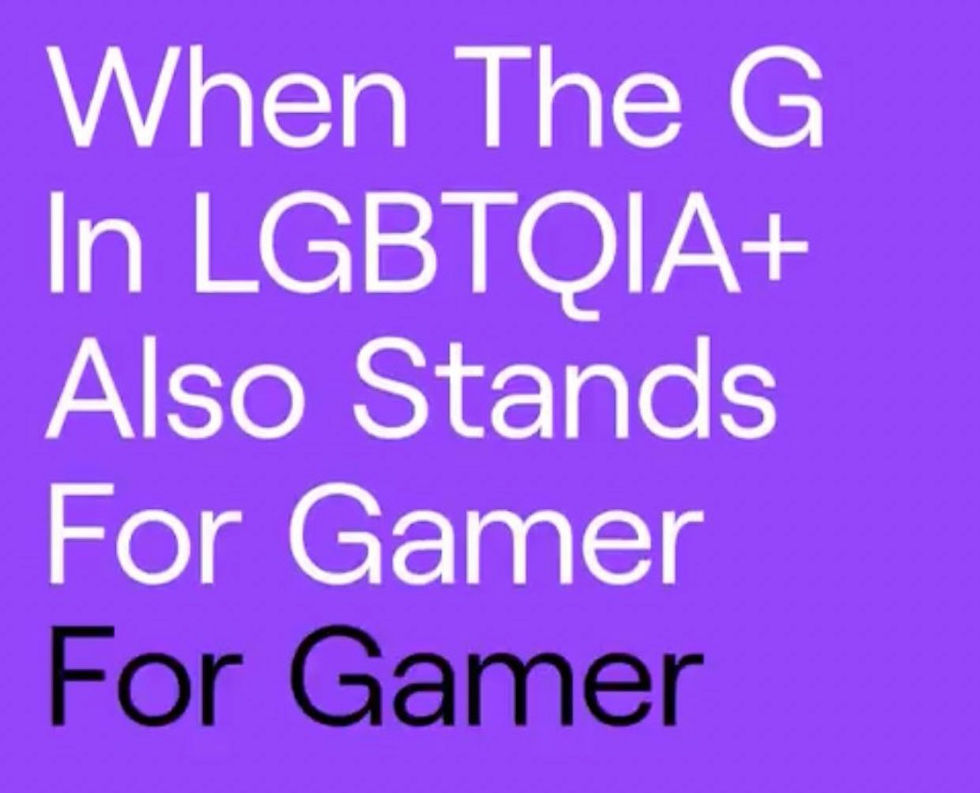
Twitch’s LGBT+ Advertisement. From @iamBrandonTV on Twitter. https://twitter.com/iamBrandonTV/status/1279881095253819392/photo/1
As the representation in video games shifts so does the community surrounding those games. To celebrate pride month this year Twitch, the largest video game streaming platform, ran an advertisement that stated, “The G in LGBT stands for Gamer.” This was met with laughs and criticisms from the queer community and was soon taken down. However, the fact that Twitch even tried to make an inclusive statement says something about the gaming community itself – it is growing.
Bibliography
Belmonte Ávila, Juan Francisco. “Corporeality, Identity, and Digital Culture: Gender and Sexuality in Video Games.” PhD diss., University of Murcia, 2015.
Chan, Nicholas, Eniko, Dan Luffey, Luke Miller, Cade Peterson, SWERY. “LGBTQ+ in Games and Media Around the World” Panel Discussion at PAX Online, Remote, September 17, 2020. https://www.twitch.tv/videos/744441756?t=00h13m04s
Elliot, Christopher J. “The History of Indie Games.” Around The Monitor. January 25, 2020. Video, 17:19. https://www.youtube.com/watch?v=xtZ2sJt4S9Y&ab_channel=AroundTheMonitor
“FAQ – Tell Me Why.” Tell Me Why Game. Last Modified September 21, 2020. https://www.tellmewhygame.com/faq/
“Final Fight – Video Game by Capcom.” Museum of the Game. Accessed October 19, 2020. https://www.arcade-museum.com/game_detail.php?game_id=7794
Kajju, Gabriella Lowgren, Callie Pepper, Jess Zammit, Pewka Zilla. “State of Queer: The Last Year of LGBTQIA+ Gaming” Panel Discussion at PAX Online, Remote, September 14, 2020. https://www.twitch.tv/videos/740617205?t=02h50m51s
Kohler, Chris. “The Secret History of Super Mario Bros. 2.” Wired. April 1, 2011. https://www.wired.com/2011/04/super-mario-bros-2/
Krobová, Tereza, Ondřej Moravec, Jaroslav Švelch. “Dressing Commander Shepard in pink: Queer playing in a heteronormative game culture.” Cyberpsychology: Journal of Psychosocial Research on Cyberspace 9(3), (2015): doi: 10.5817/CP2015-3-3
Lucas, Alexandra M. “From Smoldering Justicar to Blue-Skinned Space Babe: Asari Sexuality in Mass Effect.” In Digital Love: Romance and Sexuality in Games, edited by Heidi McDonald, 69-76. Boca Raton: CRC Press, 2018.
Mosca, Ivan. “Ontonology of Gender in Computer Games.” Mise au Point 6, (2014): doi: 10.4000/map.1631
Petit, Carolyn. “Is Ghirahim Gay or Just Coded That Way? | Queer Tropes in Video Games.” Feminist Frequency. March 5, 2019. Video, 12:28. https://youtu.be/w-5jnTv-OMg
Ruberg, Bonnie. Video Games Have Always Been Queer. New York: New York University Press, 2019.
Sens, Jeffrey. “Queer Worldmaking Games: A Portland Indie Experiment.” QED: A Journal in GLBTQ Worldmaking 2, no. 2 (2015): 98-107. Jstor.
Shaw, Adrienne. Gaming At The Edge: Sexuality and Gender at the Margins of Gamer Culture. Minneapolis: University of Minnesota Press, 2014.
Sipocz, Daniel. “Affliction or Affection: The Inclusion of a Same-Sex Relationship in The Last of Us.” In Queerness in Play, edited by Todd Harper, Meghan Blythe Adams, Nicholas Taylor, 81-96. Cham: Springer Nature Switzerland AG, 2018.
“Super Mario Bros. 2 Instruction Booklet.” Accessed October 20, 2020. https://www.nintendo.co.jp/clv/manuals/en/pdf/CLV-P-NAADE.pdf
Takahashi, Dean. “Newzoo: 2.7 billion gamers will spend $159.3 billion on games in 2020.” GamesBeat. May 8, 2020. https://venturebeat.com/2020/05/08/newzoo-2-7-billion-gamers-will-spend-159-3-billion-on-games-in-2020/
Wilberg, Heather M. “What’s in a Game? Race, Gender, and LGB Representation in Video Games.” MA diss., Roosevelt University, 2011.
[1]Dean Takahashi, “Newzoo: 2.7 billion gamers will spend $159.3 billion on games in 2020,” GamesBeat. May 8, 2020. https://venturebeat.com/2020/05/08/newzoo-2-7-billion-gamers-will-spend-159-3-billion-on-games-in-2020/ [2] Nicholas Chan et al. “LGBTQ+ in Games and Media Around the World” Panel Discussion at PAX Online, Remote, September 17, 2020. https://www.twitch.tv/videos/744441756?t=00h13m04s [3] Bonnie Ruberg, Video Games Have Always Been Queer (New York: New York University Press, 2019) 35. [4] Ruberg 31. [5] “Super Mario Bros. 2 Instruction Booklet,” accessed October 20, 2020. https://www.nintendo.co.jp/clv/manuals/en/pdf/CLV-P-NAADE.pdf [6] Chris Kohler, “The Secret History of Super Mario Bros. 2,” Wired. April 1, 2011. https://www.wired.com/2011/04/super-mario-bros-2/ [7] Ivan Mosca, “Ontonology of Gender in Computer Games,” Mise au Point 6, (2014): doi: 10.4000/map.1631 [8] “Final Fight – Video Game by Capcom,” Museum of the Game, accessed October 19, 2020. https://www.arcade-museum.com/game_detail.php?game_id=7794 [9] Mosca. [10] Mosca. [11] Carolyn Petit, “Is Ghirahim Gay or Just Coded That Way? | Queer Tropes in Video Games,” Feminist Frequency, March 5, 2019, Video, 12:28. https://youtu.be/w-5jnTv-OMg [12] Heather M Wilberg, “What’s in a Game? Race, Gender, and LGB Representation in Video Games,” MA diss., Roosevelt University, 2011. [13] Adrienne Shaw, Gaming At The Edge: Sexuality and Gender at the Margins of Gamer Culture (Minneapolis: University of Minnesota Press, 2014) 25. [14] Alexandra M Lucas, “From Smoldering Justicar to Blue-Skinned Space Babe: Asari Sexuality in Mass Effect,” In Digital Love: Romance and Sexuality in Games, edited by Heidi McDonald, 69-76. Boca Raton: CRC Press, 2018. [15] Tereza Krobová et al. “Dressing Commander Shepard in pink: Queer playing in a heteronormative game culture,” Cyberpsychology: Journal of Psychosocial Research on Cyberspace 9(3), (2015): doi: 10.5817/CP2015-3-3 [16] Mosca. [17]Juan Francisco Belmonte Ávila, “Corporeality, Identity, and Digital Culture: Gender and Sexuality in Video Games,” PhD diss., University of Murcia, 2015. [18] Shaw. 34. [19] Daniel Sipocz, “Affliction or Affection: The Inclusion of a Same-Sex Relationship in The Last of Us.” In Queerness in Play, edited by Todd Harper, Meghan Blythe Adams, Nicholas Taylor, 81-96. Cham: Springer Nature Switzerland AG, 2018. [20] Christopher J. Elliot, “The History of Indie Games,” Around The Monitor, January 25, 2020. Video, 17:19. https://www.youtube.com/watch?v=xtZ2sJt4S9Y&ab_channel=AroundTheMonitor [21] Jeffrey Sens, “Queer Worldmaking Games: A Portland Indie Experiment,” QED: A Journal in GLBTQ Worldmaking 2, no. 2 (2015): 98-107. Jstor. [22] Chan et al. [23] Kajju et al. “State of Queer: The Last Year of LGBTQIA+ Gaming” Panel Discussion at PAX Online, Remote, September 14, 2020. https://www.twitch.tv/videos/740617205?t=02h50m51s [24] “FAQ – Tell Me Why.” Tell Me Why Game. Last Modified September 21, 2020. https://www.tellmewhygame.com/faq/
Comments